
Andrei Livadny · 2017–2018 · an unofficial reader’s companion
Expansion: The History of the Galaxy
Three novels from a sixty-book Russian future history: a young man sealed in a capsule on a fog-drowned Earth, a farm machine against an invasion four centuries later, and teenage gamers wired into war machines that learn their minds.
Andrei Livadny’s History of the Galaxy, «Экспансия. История Галактики», is a Russian future history in some sixty novels, novellas and stories, running from a poisoned Earth in the twenty-second century to the thirty-ninth. Magic Dome Books translated three of its novels in 2017 and 2018 and published them in English as Expansion: The History of the Galaxy: Blind Punch, The Shadow of Earth and Servobattalion. Each is a standalone with its own cast, set in 2197, 2607 and 2624, and together they make one history: the second book remembers the first, and the third is fought in the war the second begins.
This is an unofficial reader’s companion to the three: each novel summarized by its movements and walked in painted frames, in the manner of a European ligne-claire science-fiction comic album. Here are the arc of each book, how the three connect, the cast and the reading order. It spoils everything, endings included, as far as the sources reach: the publisher posted each book’s opening chapters in English, and past them the book pages follow previews, summaries and readers’ reviews, and say so.
As of October 2026 no film, series, animation, game, comic or audio drama of the History of the Galaxy has been found, and no option has been reported, so in place of screen pages this walk has a page on the history itself, which also sets out what was searched.
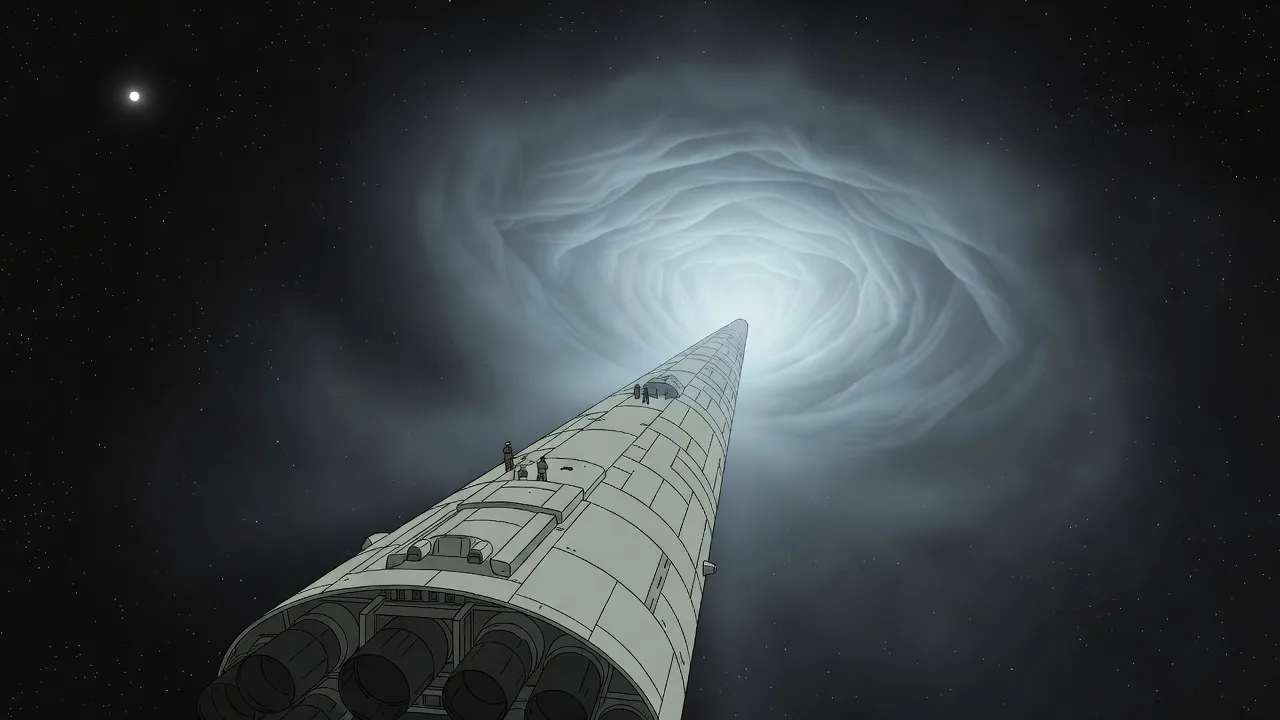 The History of the GalaxyThe fog and the Layer, the hypersphere and the Great Exodus, the Terran Alliance’s war and its machines, and where the three English books fall, on one page.See the history →
1
Three Books, Four Centuries
The History of the Galaxy was never planned. Livadny, born in 1969 and raised near St Petersburg, signed his first contract with Eksmo in 1997; in 2002 he arranged novels he had already written into one consistent line, and his overview of January 2017 counts sixty works, eighty-three planets, sixteen alien races, the Great Exodus and two Galactic Wars. His English publisher’s catalogue says the series has “only one protagonist: the human race itself”, and the author told Magic Dome in 2017:
“I made a point of not specifying which nation colonized the Galaxy”
The history runs like this. In the twenty-second century four corporations rule an Earth whose biosphere has died; its cities drown in industrial fog, and billions live sealed in capsules, spending their lives in a cyberspace called the Layer. The theory of the hypersphere opens the stars, and in the Great Exodus thousands of colony transports leave over half a century, most of them on blind jumps that scatter their crews across thousands of star systems. Centuries later a rebuilt, overcrowded Earth under John Winston Hammer’s Terran Alliance turns on the colonies its emigrants founded, and in 2607 begins the First Galactic War, which by the author’s chronology lasts thirty years and ends with the Alliance’s capitulation. The Russian cycle runs on to the thirty-ninth century.
Magic Dome Books picked three novels from three points on that line, written in 2013, 2000 and 2007, and numbered them by the history: read in order, they move forward four hundred years and then seventeen. The cycle’s word for a jump into the hypersphere with no charts to steer by, «слепой рывок», a blind jump, is the Russian title of the first; the English renders it Blind Punch. The English series stopped at three; FantLab’s page for «Дабог» notes that, by the author’s account, its translation flopped.
2I · Blind Punch (2017)
The Prologue opens on the Plaza of Five Corners in the Europe Megacity, where nobody stops for an unshaven street violinist except a woman in a dark blue evening dress, who applauds. She is Cathy Rimp, owner of Rimp Cybertronics, the world’s largest corporation; he is an artificial intelligence in a body of servotoys and foam flesh. Earth is days from war, and each of the four superpowers has secretly built an AI to run its combat robots. Rimp cuts his connection to the Net and tells him:
“We will leave the poisoned Earth behind. We will reach for the stars.”
He refuses to destroy the military AIs, which are not yet self-aware, so she asks him to play, and while he plays, a chip in his violin finds its way into the AI network and carries her program into the military AIs of four superpowers.
Chapter One is dated 12 November 2197. Max Bourne, who turns twenty tomorrow, wakes in his in-mode, one of five capsules hung under the ceiling of a refitted studio flat; his family has lived in in-modes for thirteen years. Four billion of Earth’s eighteen billion people live sealed like this and live their real lives in the Layer, a cyberspace of four tiers ranked by status; people in capsules are called cans. In the Layer Max has met Lisa, a plain, oddly mysterious student from the Upper Layer. She tells him the cruel truth: the cans fill the places of banned game bots, and he will stay in his capsule forever. Later she tells him “None of this is real,” leaves him her real-world number, and hints that her father made his fortune on the movement of industrial fog.
At twenty Max gets 5,000 credits from the World Government and spends them all hiring an expert neuronet, which predicts that the fog is about to drop in parts of the Europe Megacity. A private investor lends him 190,000 credits against his own and his parents’ in-modes and the family’s Antarctic rights, signed through his parents’ implants without their knowledge. Max buys ten empty capsule apartments, leaves the can rather than face his parents, and grows rich when the fog drops. “Above the clouds,” he tells a flycar.
That same morning Rimp asks Ulrich Fitzgerald, the old founder of Genesis, to help pay for the Alpha, the first interstellar colony transport; he shares her verdict on Earth but sets harsh terms, and Bryzgalov of Megapool orders the ship sabotaged at its launch. There the publisher’s English excerpt ends.
The rest is known from the blurb, Russian reviews and the author’s notes. The blurb promises military AIs and survival in the distant Outlands; reviewers recall a Robinson Crusoe stretch on Ganymede, space pirates, and the theory of the hypersphere with the first flights through it. By the end, the author’s notes say, Cathy Rimp leaves the dying Earth on a colony transport with her corporation’s specialists, the engineer Hans Gervet among them, and Max survives; Livadny says his hero “faced a life-threatening emergency and came out the winner”. The book I page walks it movement by movement.

1 No Heartbeat Blind Punch, the Prologue. On a restaurant balcony above a hall of holographic diners, Cathy Rimp, owner of Rimp Cybertronics, lays her palm on the chest of the street violinist who calls himself Richard, and feels only cold. He is an artificial intelligence in a body of servotoys and foam flesh. Before the evening is out she will use his violin to carry a program into the military AIs of four superpowers.

2 Five Capsules at Dawn Chapter One, 12 November 2197. Five in-modes, sealed capsules three metres long, swing down from the ceiling of a refitted studio flat and stand upright, and Max Bourne, who turns twenty tomorrow, wakes in one of them into a despair he cannot explain. Four billion of Earth’s eighteen billion people live in capsules like these and spend their days in the Layer. Max’s way out will be a gamble on the fog outside the window.
II · The Shadow of Earth (2018)
Four hundred years on, the fog is gone. “Earth was an eternal city”: one technosphere over every continent, sixty billion people, four in five of them on subsidies. John Winston Hammer, the short man who heads the World Government, founded the Terran Alliance with five ancient warships and an ice-hauler pilot from the Belt, Alexander Nagumo, whose price was the title of admiral. Every accessible world within one hyperjump was settled in the Exodus, and Earth decides to take one anyway: Dabog, a thriving farming colony founded by the transport Fugitive, to be struck from orbit as an example to every colony.
On 9 October 2607 a young teacher, Daria Kretchetova, brings her class to the Colonization History Museum, where holograms show the colony’s founders and Aquila, the Rokotov family’s walking farm machine. Overhead three cruisers, black under their phantom generators, lead the Terran fleet in; one of them, the Shadow of Earth, gives the book its English title. Its megacity killers find the ancient reactors buried under two cities, and two mushroom clouds climb into the stratosphere.
Igor Rokotov, thirty-seven, a historian of the colony, keeps the restored Aquila in the museum’s hangar. He finds Daria and the children in the dark, fits the tunnelling lasers he had readied for an anniversary show, leaves them sealed in, and walks the machine out into crimson clouds and falling ash. Through Aquila’s hidden cryptographic subsystem he hears the Terran major at the capital order the bunker seals blown or gas pumped into the shelters. Ambushed by a combat vehicle, he cuts it apart, and with that first kill, the narrator says, the Galactic War began. Nagumo orders an orbital barrage on top of his own troops; Aquila walks through it, and one antique farm machine breaks a fleet’s landing. The surviving ships lift off and abandon their assault teams, and Igor ends Part 1 unconscious in the crippled machine.
Past Part 1 the book is known only from summaries and trope wikis. They agree that the landing is beaten and that nuclear strikes ruin Dabog’s biosphere, though not on when they fall (one gives it a century to recover); one wiki follows a Terran soldier, very probably Andrew Groves, jailed since the age of five, who ends up fighting the invaders. The attack meant to frighten the colonies unites them, and a week-long blitzkrieg becomes the thirty-year First Galactic War. What becomes of Igor and Daria, the sources do not say. The book II page follows the first day almost hour by hour.

3 “Come Back Soon” The Shadow of Earth, an hour after Earth’s first strike on Dabog. Under the shattered museum, Igor Rokotov, a historian of the colony, has fitted tunnelling lasers to his family’s antique servomachine, Aquila, to cut a way out; the teacher Daria Kretchetova and her class must stay sealed in the bunker. Until today the two had only nodded in passing; now she hugs him and whispers, “Be careful... and come back soon.”

4 The First Duel On his way to send help back to the museum, Igor is ambushed in a withered plantation: a Terran combat vehicle tears Aquila’s cabin open with plasma and missiles. Concussed, he flicks off the laser safety and the shoulder lasers cut the vehicle apart, while the Terran major assures the watching infantry that the steaming giant is only a colonists’ farm robot. With that first kill, the narrator says, the Galactic War began.
III · Servobattalion (2018)
Seventeen years later, in what the book calls the fifteenth year of the war, the Alliance has still not taken the developed colonies. The Prologue, dated 2627 in the English, comes after the battle the book is about: on the volcanic world Vesuvius, a repaired Hoplite whose AI will not speak to its test pilot throws him out on the emergency catapult and runs the test course alone. Its AI, the range chief explains, lost her pilot in the last battle; most of the batch came from the Thirteenth Servobattalion.
On 25 June 2624 two hundred recruits aged seventeen to nineteen land on Yunona, Book II’s dead colony, now a weapons laboratory hidden under pines that grow ten metres a year. They are kids from Earth’s megacities, picked for their scores at servomachine combat in the Layer’s tournament arena, and their captain tells them quietly:
“There may be no living combat companions beside you, only machines.”
Simon Green, cocky and slangy, and Anton Verkholin, skinny and watchful, decide to stick together. On 18 July Hammer dies and the old Nagumo takes his offices, and Admiral Kupanov, seeing a chance to rise, briefs his fleet for a raid on Ankor, a Colonial world where captured Alliance servomachines are studied. The designer Howard Faragney, whose Maverick AIs learn from pilots wired into them, has built his newest, Beatrice-4, which no longer filters the pilot’s thoughts; Major Herpack calls him a killer, and Faragney thinks himself cursed.
On 12 August twenty of the two hundred, Simon and Anton among them, go to war in the Thirteenth Servobattalion, each sub-unit under a seasoned officer. Seven Nibelung carriers, posing as a Colonial convoy the Alliance has already seized, codes and all, slip through Ankor’s defences and drop the battalion’s machines in armoured containers onto the bunker zone, where their landing jets raise a black cloud that blinds the watchers in orbit. There the Russian preview runs out, with Simon’s container jammed and, at last, a voice on the net.
From here the book is known from annotations and reviews: the battalion fights for Ankor for a single day, in long, closely detailed battles of walking machines; the operation’s real purpose, the Russian annotation says, turns out to be something quite different, and two reviews point to treachery from above. By the end, one reviewer writes, all the main heroes die or pass to another stage of development, which recalls the blurb’s promise of a pilot’s mind living on in the machine. As the blurb puts it:
“The war of humans is gradually transforming into a war of machines.”
The book III page walks the day as far as the sources reach.

5 Let’s Stick Together Servobattalion, 25 June 2624. Two hundred recruits from Earth’s megacities land on Yunona, the dead colony of the second book turned into a weapons world under pines that grow ten metres a year. Walking to the barracks, cocky Simon Green falls in with skinny, watchful Anton Verkholin, who has already worked out why they are here: they were picked for their scores at servomachine combat in the Layer’s tournament arena.

6 Good Morning, Pilot Simon climbs into his machine’s cradle, switches on his implant, and a soft female voice says “Good morning, pilot.” She is Beatrice-4, Howard Faragney’s newest Maverick module, two and a half thousand neurochips that learn from the pilot’s mind and no longer filter his thoughts. Simon calls her his e-girlfriend. She corrects him: “I am not a girlfriend. I am your combat companion.”
One History
The three books were written out of order and sold as standalones, but they share one history, and the English editions keep its threads tied.
The first runs from Earth to Dabog. In 2016 Livadny revised the Russian ending of «Слепой рывок» so that the transport Rimp’s people leave on is the Fugitive, the ship that founds Dabog; «Беглец» (2019), the novel of its voyage, is untranslated. The Shadow of Earth reaches back across the gap. Its museum keeps the Fugitive’s armour plate; Daria names the founders, Max Bourne, Catherine Rimp, her daughter Chloe and the engineer Hans Gervet; and Igor has found the diaries of Max Bourne, who became the pilot of the very first servomachine on Dabog. The Russian calls that pilot Ivan Stozharov, as it calls Blind Punch’s hero, and the English calls them both Max Bourne. Earth remembers Fitzgerald, who cleared its air and emptied the in-modes, and keeps the four corporations as half-erased logos on Hammer’s first warships.
The second is the war’s high command. Hammer’s decision starts the war, and Nagumo commands the strike on Dabog from the flagship Endgrouse, with the young admiral Tiberius Nadyrov under him. In Servobattalion Hammer dies and Nagumo takes his offices; its flashbacks make Nadyrov Nagumo’s rival in the war’s early years, and Admiral Kupanov began his career on the Endgrouse’s artillery deck in that first attack.
The third is the machines, and the word servo grows with them. In Blind Punch servos are small service robots that scrub façades. On Dabog, Gervet built the first servomachine from the giant loader that stripped the Fugitive’s armour, with the bionics of the planet’s great lizards, and every family came to own one; Aquila is the Rokotovs’. After the defeat at Dabog the Alliance shows its engineers walking war machines of its own, made “as an analogy for the walking servomachines of Dabog”, and the first Maverick AIs lose one fight after another to Dabog’s refitted farm walkers. Faragney’s answer is to wire a human pilot into the machine, and Beatrice is where that leads. The Layer runs through all three as well: the cans live in it in the first book, Fitzgerald has blocked it by the second, and in the third the Alliance picks its pilots from its arena.

7 The Family Machine Where the first book is remembered. In the museum on Dabog, some four hundred years after Blind Punch, Daria names the colony’s first generation for her class: Max Bourne, Catherine Rimp, her daughter Chloe, and the engineer Hans Gervet, who built the universal servomachine from the loader that stripped the transport’s armour. Every family once owned such a machine. The hologram shows one of them, Aquila, the Rokotov family robot.

8 Dabog’s Farm Walkers Where the second book is remembered. Faragney recalls how the Alliance’s servomachines began: after the defeat at Dabog its engineers were shown walking war machines modelled on Dabog’s, and from December 2609 his group wrote the first Maverick AI. Against Dabog’s refitted farm walkers, piloted by colonists in full neurosensory contact, the first Mavericks lost one fight after another. His answer was to wire a human pilot into the machine.
Reading Them
Read them in the English order, which is the history’s: Blind Punch, The Shadow of Earth, Servobattalion. Each stands alone with its own cast and a complete story, but in order the second book’s museum remembers people the reader has met, and the third book’s machines carry the second book’s war in their design. Start with Blind Punch, which builds the Earth the other two remember.
Between the first and second books lies «Беглец», the untranslated middle of the Russian trilogy «Слепой рывок» – «Беглец» – «Дабог», so in English the Fugitive’s voyage happens offstage. Between the second and third the Russian cycle has five more episodes, and one of them is in English: The Island of Hope («Остров Надежды», 1997), Magic Dome’s first Livadny translation, published in 2015 without the series label. All three novels are on audio from Tantor, read by Aaron Shedlock.
The cast across three books
Max Bourne
Lisa
Cathy Rimp
The violinist
Ulrich Fitzgerald
Igor Rokotov
Daria Kretchetova
Aquila
John Winston Hammer
Alexander Nagumo
Simon Green and Anton Verkholin
Beatrice
Howard Faragney
Admiral Kupanov
Reading order
- The English order is the history’s order. I Blind Punch (Magic Dome Books, Kindle 12 September 2017), set from 2197; II The Shadow of Earth (22 March 2018), 2606–2607; III Servobattalion (e-book 22 October 2018, paperback 8 November 2018), 2624 with a prologue dated 2627. The Russian originals were written in 2013, 2000 (rewritten 2017) and 2007.
- Where to start: Blind Punch. Each book stands alone with its own cast, but the second remembers the first and the third is fought in the second’s war.
- Between I and II (untranslated): «Мишень» (set 2215) and «Беглец» (The Fugitive, 2019, set 2218), the voyage of the Fugitive to Dabog and the middle of the Russian trilogy «Слепой рывок» – «Беглец» – «Дабог».
- Between II and III: «Зона Отчуждения», «Возвращение Богов», «Форт Стеллар», «Остров Надежды» and «Десант на Счастье». Only «Остров Надежды» is in English, as The Island of Hope (Magic Dome Books, 2015), a standalone outside the series.
- Translators: Audible credits Sofia Gutkin for II and III; no source read for this walk names the translator of I.
- On audio: all three from Tantor, read by Aaron Shedlock: Blind Punch (21 November 2017, 9 h 1 min), The Shadow of Earth (12 June 2018, 8 h 29 min), Servobattalion (28 February 2019, 7 h 29 min). In Russian, IDDK records the cycle as numbered episodes.
- Which texts: the English Blind Punch follows the author’s revised opening; The Shadow of Earth his 2017 rewrite of «Дабог»; Servobattalion his earlier text, not the 2025 revision now sold in Russian, which renames several characters.
- The History page maps the timeline the three share; it can be read first, but it spoils all three books.
Notes
- English names first. The translations rename freely and this walk follows them: Ivan Stozharov is Max Bourne in both Blind Punch and The Shadow of Earth; Екатерина Римп is Cathy or Catherine Rimp; the family machine «Беркут» is Aquila; the AI module «Одиночка» (the Loner) is the Maverick.
- Not «Тень Земли». The Shadow of Earth is «Дабог»; its English title is the name of the Terran cruiser that fires the megacity killers. Livadny’s novel «Тень Земли», set in 3920, opens a later cycle and has not been translated.
- The author. Andrei Livadny was born on 27 May 1969, in Pskov by his English publisher’s account and in the south of Russia by his own, and grew up near St Petersburg. Magic Dome also published his LitRPG trilogies Phantom Server and The Neuro.
- The nearest thing to a screen. A GIF trailer Magic Dome made for Blind Punch, and the galleries of 3D and fan art on the author’s site.
The whole walk: The Series · The History · I · II · III